
Your Google Business Profile was suspended. You spent hours gathering documents, wrote a careful appeal, and submitted it through Google’s reinstatement tool. Then came the email: GBP appeal denied. You corrected more things, uploaded more documents, and tried again. Denied again.
If you are reading this, you are at that exact point, two rejections in, no clear explanation from Google, and no idea what they actually want. Every day your listing stays dark, your phone stays quiet while competitors collect the leads that should be yours.
This page explains exactly why a GBP appeal denial keeps recurring, what Google’s system is actually looking for that generic guides never tell you, and what our done-for-you GBP recovery service does differently to get suspended listings reinstated after multiple rejections.
Why Your GBP Appeal Was Denied: The Real Reasons Nobody Explains
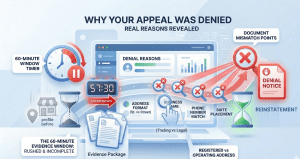 Most guides tell you the same things: match your business name to your signage, use a real address, and avoid keyword stuffing. You already know this. You have probably already done all of it. So why was your GBP appeal denied despite following every rule?
Because Google’s reinstatement process changed significantly after 2023, most advice online was written before those changes. Here is what is actually happening now.
The 60-Minute Evidence Window Problem
Since Google introduced its new Appeals Tool, once you click to begin your appeal, you have exactly 60 minutes to upload all supporting evidence. Most business owners click the button, thinking they can gather documents afterward. The timer starts. They scramble. They upload incomplete or mismatched files under pressure. Google’s reviewer sees a weak evidence package, and the GBP appeal denied status is finalized, not because the business is illegitimate, but because the upload was rushed.
Document Mismatch: The Silent Rejection Trigger
Google cross-references every document against your profile information. A single inconsistency flags the entire submission as unreliable. Common mismatches that cause a GBP appeal denied result include:
- Utility bill showing “St.” while your GBP shows “Street.”
- Business registration using a trading name, while utility bills show a legal entity name
- Phone number on documents differs from the number on the profile
- Address format inconsistencies (suite placement, “Unit” vs. “Apt”)
- Registered business address differs from the operating address on the profile
Google does not give partial credit for documents that mostly match. Any mismatch is grounds for denial, and the denial notice will never tell you which specific document caused it.
The Category and Industry Risk Profile
Certain business categories face heightened automated scrutiny. High-risk industries, including locksmiths, lawyers, plumbers, roofers, financial advisors, moving companies, and addiction treatment centers, are reviewed against a stricter evidence standard. The same documents that reinstate a florist’s listing may not be sufficient for a contractor’s listing, which is why so many legitimate businesses in these categories repeatedly receive a GBP appeal denied notification.
Home-Based and Service-Area Business Complications
Home-based businesses and service-area businesses face a structural conflict. Google requires proof of a real-world presence but instructs these businesses to hide their address. You are supposed to prove you exist at an address you are told not to display. Most business owners do not know how to structure this evidence correctly, which results in repeated GBP appeal-denied outcomes for otherwise legitimate operations. If your listing has been removed entirely from Search and Maps, you may be dealing with a suspended GBP listing that requires a different recovery approach than a standard appeal.
Re-Appealing Without Changing the Evidence Package
This is the most common post-denial mistake. Google’s system logs every submission. When a second appeal arrives with the same or minimally changed evidence, the second GBP appeal denied comes faster than the first. Uploading the same business license again is not a stronger appeal, it is the same appeal. Successful recovery requires genuinely new evidence and a fundamentally different documentation strategy.
What Google Actually Wants to See in 2025–2026
Google’s reinstatement process has shifted from a form-submission exercise to a structured legitimacy-proof. To avoid another GBP appeal denied outcome, your evidence must meet three tiers.
Tier 1: Core Identity Documents
These are non-negotiable. Every appeal must include all of the following, and every detail must match exactly across all documents:
- Government-issued business registration or incorporation certificate
- Utility bill dated within 90 days showing business name and address
- Business bank statement header showing business name and address
- Tax registration certificate or EIN confirmation
If any variation exists between documents, normalize your GBP listing to match them before filing.
Tier 2: Physical Presence Evidence
Google increasingly requires visual proof of on-site operations. Without it, the risk of a GBP appeal denied result rises significantly. This includes:
- Exterior signage photos with the business name clearly visible
- Interior branded workspace images, service vehicles, or equipment
- Storefront photos taken during business hours
- Video verification showing the operating premises, signage, and owner identification
For service-area businesses operating from home, branded vehicles, an organized workspace, and visible business materials serve as acceptable substitutes.
Tier 3: Third-Party Credibility Signals
Strong appeals include evidence that exists independently of Google, signals Google did not create and cannot easily fabricate:
- Business license issued by a local municipality or state authority
- Industry certifications and professional licensing
- Insurance certificates showing the business name and operating address
- Active, consistent directory listings on BBB, Yelp, and Yellow Pages that match your GBP exactly
A Better Business Bureau listing that predates your GBP tells Google your business existed before the profile, which directly reduces the likelihood of a spam flag.
DIY Appeal vs. Professional Reinstatement: What Is the Difference
Most business owners dealing with repeated GBP appeal denied responses are not facing an illegitimate listing problem. They are facing an appeal strategy problem.
| Typical DIY Appeal | Professional Done-For-You Recovery |
| Submits documents without auditing for mismatches | Audits all documents against the GBP listing before submission |
| Rushes evidence upload within 60-minute window | Prepares complete package before initiating appeal |
| Resubmits same documents after denial | Builds a genuinely new evidence strategy each time |
| Uses generic appeal language | Writes a structured argument addressing the specific suspension trigger |
| No knowledge of industry-specific review standards | Applies category-appropriate evidence standards |
| No access to escalation channels | Escalates directly to Google Product Experts when needed |
If your profile has been flagged or access restricted rather than fully suspended, our GBP disabled recovery process addresses that specific scenario with a different documentation and escalation path.
What Happens When You Hire Us: Our 5-Step Recovery Process
When you engage our professional GBP reinstatement service after a GBP appeal denied notification, here is exactly what we do.
Step 1: Full Profile and Suspension Audit
Before anything is submitted, we conduct a complete audit of your suspended profile, Google account history, previous appeal submissions, and all documents you have provided. We identify the specific trigger that caused your suspension and exactly what the previous appeals got wrong. Most clients discover document mismatches or evidence gaps they were never aware of. This audit is what makes every subsequent step more effective.
Step 2: Profile Compliance Correction
Appealing a non-compliant profile is one of the primary reasons a GBP appeal denied result repeats. Before filing anything, we bring your profile into full compliance with Google’s current guidelines, correcting NAP inconsistencies, resolving category issues, and fixing any service area configuration problems that contributed to the original suspension. We do not submit an appeal until the profile itself is clean.
Step 3: Evidence Package Construction
We build a complete, cross-verified evidence package before touching the appeal tool. Every document is checked against your profile. All names, addresses, and contact details are normalized across the entire package. We assemble Tier 1, Tier 2, and Tier 3 evidence appropriate to your business type and industry. For high-risk categories, we build beyond the standard evidence threshold because we know exactly what Google’s reviewers require.
Step 4: Structured Appeal Submission
We write the appeal narrative, not a generic explanation, but a structured argument that directly addresses the likely suspension reason, explains what has been corrected, and presents evidence in the order most likely to result in reinstatement. We manage the entire 60-minute upload window ourselves. Nothing gets rushed. Nothing gets missed.
Step 5: Communication Management and Escalation
We handle all Google communication from submission through resolution. If the standard process fails, we escalate directly to Google Product Experts, reviewers who can evaluate cases the automated system has repeatedly denied. This escalation channel is not available through the standard appeals tool, and it is frequently the difference between a listing that stays permanently dark and one that gets successfully restored.
Real Situations Where GBP Appeal Denied Keeps Repeating
Based on the cases we handle most frequently, these are the scenarios where business owners face denial after denial.
Suspended for Deceptive Content With No Clear Explanation
Google’s AI applies this label algorithmically when your profile does not match its model of a legitimate business, most often triggered by recent name changes, address updates, or ownership transfers. A deceptive content suspension requires more than just submitting documents. It requires building a narrative that explains the change and proves the current profile accurately represents the real business. (Full guidance on this suspension type is covered on our dedicated deceptive content page.)
Suspended After a Marketing Agency Was Given Profile Access
If an agency with a history of policy violations was given access to your profile, Google may have suspended your legitimate listing by association. The business owner then submits an appeal as if they caused the suspension themselves, which results in denial because the real trigger was the agency account history. Recovering requires removing the agency, demonstrating the association was the trigger, and rebuilding the evidence package around the business owner’s independent legitimacy.
Home-Based Business With Address Verification Conflicts
No storefront, no signage, no visible public presence, but utility bills and business registration all point to a home address you are required to hide. We resolve this by building evidence around branded vehicles, customer communications, work portfolios, and insurance certificates that collectively prove active business operations from the registered address.
Frequently Asked Questions About GBP Appeal Denied
Why Does Google Keep Denying My GBP Reinstatement Appeal?
The most common reasons for a repeated GBP appeal denied result are document mismatches, incomplete evidence packages assembled under pressure, and non-compliant profiles. Repeated appeals without new evidence damage your case progressively. Never create a new listing while one is suspended, as this will result in further denials and can permanently harm your reinstatement chances.
How Many Times Can I Appeal a GBP Suspension?
There is no hard limit, but repeated submissions with the same evidence accelerate denials. Each submission is logged. After two or three self-submitted rejections, the path to reinstatement typically requires either new evidence Google has not yet seen or escalation to Google Product Experts through channels unavailable in the standard appeals tool.
What Is the Difference Between a Soft Suspension and a Hard Suspension?
A soft suspension makes your listing unverified but still visible to the public. A hard suspension removes it entirely from Google Search and Maps. Hard suspensions require a more complete evidence package and typically take longer to resolve. Account-level suspensions are the most serious and affect every profile managed under the suspended Google account.
How Long Does GBP Reinstatement Take After Appeal?
Google states a five-day review window, but real-world timelines in 2025–2026 run 20 to 30 business days for straightforward cases and four to eight weeks for cases involving previous denials, high-risk industries, or Product Expert escalation. (A full breakdown of reinstatement timelines by case type will be available on our dedicated timeline page when published.)
Can I Create a New GBP Listing While My Current One Is Suspended?
No. Creating a duplicate listing while your original is under suspension is a direct policy violation. The duplicate will be removed and the action will be used against your reinstatement case. Do not create a new listing, do not ask employees or family members to create one, and do not attempt to re-register the same business under a different Google account.
What Documents Do I Need for a GBP Reinstatement Appeal?
At minimum: government-issued business registration, utility bill dated within 90 days, business bank statement header, and tax registration certificate. For high-risk industries or second and third denials, you also need physical presence evidence and third-party credibility signals, including business licenses, industry certifications, insurance certificates, and consistent directory listings.
Is It Worth Hiring a Professional Service After Multiple Denials?
After two or more GBP appeal denied responses, yes. The cost of professional recovery is almost always less than the weekly revenue lost from an invisible listing. For local businesses where Google Maps drives the majority of inbound leads, a suspended listing is a revenue emergency, not a minor inconvenience.
Your GBP Appeal Has Been Denied. Here Is What to Do Next.
If you have received two or more GBP appeal denied responses, submitting the same appeal a third time will not produce a different result. Every day your listing stays suspended, your competitors on Google Maps collect the calls, clicks, and customers your listing should be generating. The longer it stays dark, the more ground you have to recover even after reinstatement.
Contact us today for a free assessment. Tell us how many times your appeal has been denied, what business category you are in, and what documents you have submitted so far. We will identify exactly what went wrong, what is missing, and what a successful recovery looks like for your specific situation.