Let’s be honest: the global market hasn’t just shifted; it’s been turned inside out. There was a time, and it wasn’t even that long ago, when a business could get by on a couple of reliable tricks. Maybe a well-placed print ad, a local billboard, or a steady stream of word-of-mouth. But in our current hyper-connected world, the “landscape” isn’t a physical place anymore. It’s a massive, 24-hour digital ecosystem that literally never sleeps. Traditional marketing isn’t failing because it’s “old-fashioned.” It’s failing because it’s too static for a world that moves at the speed of light. Modern customers are restless, and they expect the brands they deal with to be just as quick on their feet.
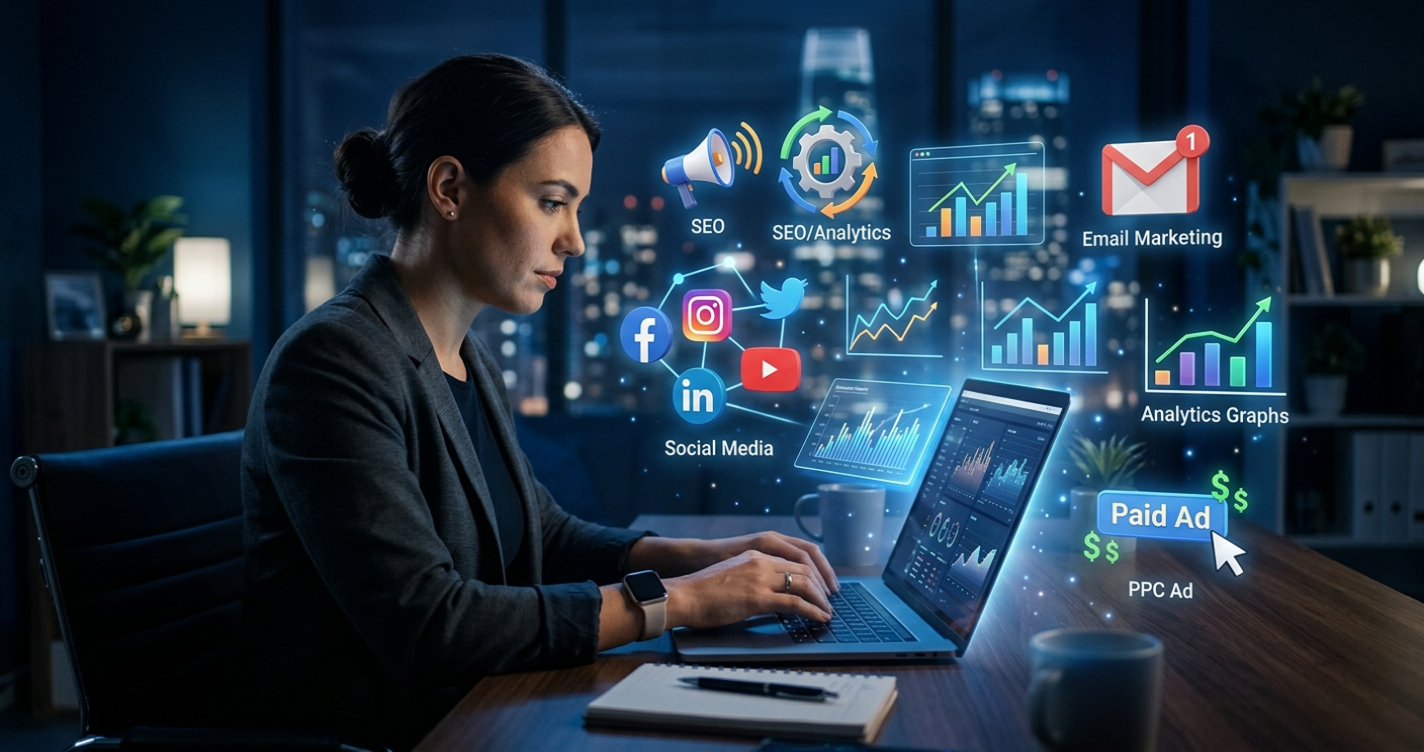
The real point of this digital marketing guide is to pull your focus away from that messy drawer of random “tactics.” Too many businesses get stuck in the “activity trap”, doing a bit of SEO here and throwing some cash at ads there, but nothing actually talks to each other. Without a solid plan, these disconnected efforts usually pull in opposite directions. Or worse, they leave your customers totally confused about who you actually are. A real strategy is an integrated roadmap. It’s a setup where every tweet, every minor technical tweak, and every email work in total harmony toward one thing: real, lasting growth.
At the very heart of these digital marketing strategies is the one thing big data often ignores: the human connection. In a world obsessed with numbers, agencies often treat people as just “sessions” or “conversion rates.” That is a massive mistake. Sophisticated, modern marketing is about remembering that behind every click is a real person. They have a specific problem, a unique set of worries, and a simple hope for a solution that actually works. When you stop “capturing leads” and start “helping people,” you build the kind of trust that ignores borders and creates fans for life.
What Makes a Digital Marketing Strategy Effective?
Before you spend a penny on ads or write a single post, you need a foundation that won’t crumble under pressure. This starts with “The Blueprint,” or what we call the “Discovery” phase. It is a classic error: businesses pouring money into the “next big thing” without actually knowing who they are talking to. A successful digital marketing guide puts the work in early. It prioritises understanding the real-world pain points, the online habits, and the actual buying triggers of the audience. By digging into the research and spotting the gaps your competitors missed, you make sure every pound spent later is a strategic investment, not a blind gamble.
The Multi-Channel Safety Net
One of the biggest traps for growing brands is “putting all their eggs in one basket.” Whether it’s a sudden tweak to a social media algorithm or a total shift in how Google ranks sites, relying on just one platform is a massive business risk. A smart digital marketing strategy thrives on a Multi-Channel Approach. By spreading your presence across organic search, paid ads, and direct email, you build a vital safety net. This “omnichannel” way of working means that if one channel has a bad month, your brand is still visible elsewhere, keeping the enquiries coming in and your authority solid across the web.
Technical Integrity: Your Digital Storefront
The final “anchor” holding these strategies in digital marketing together is Technical Integrity. Think of your website as your digital storefront. If the door is stuck (slow loading), the lights are off (insecure), or the aisles are a mess (bad mobile navigation), nobody is going to stay and buy. Google and other search engines now treat “User Experience” (UX) as a top-tier ranking factor. A mobile-responsive design isn’t a “luxury” anymore; it’s the bare minimum for a global audience browsing on their phones. Making sure your site is fast, secure, and accessible provides that final professional polish that turns a casual visitor into a committed client.
Search Engine Optimisation (SEO): The Long-Term Growth Engine
In today’s world, SEO has grown up. It’s no longer about technical “tricks” or gaming the system; it is a pillar of real business credibility. For strategies in digital marketing to actually work, they have to look Beyond Rankings. Years ago, you just wanted to be #1 for a specific word. Now, the game is “User Intent.” Search engines have become incredibly smart at figuring out the why behind a search. A pro-level SEO strategy identifies the exact questions your potential clients are asking, whether they need a quick fact, are comparing their options, or are ready to buy right now, and ensures you are the most helpful voice in the room.
To get this right, you have to balance two sides of the same coin: On-Page and Off-Page SEO. In simple terms, On-Page SEO is your “Technical Health.” It’s your site speed, your mobile friendliness, and the quality of your content. Off-Page SEO is your “Brand Authority.” It’s about building a reputation across the internet through quality links, social signals, and digital PR. On-Page tells the bots what you do; Off-Page proves to them that you are the trusted leader in your field.
The “Human” Algorithm
The absolute “secret sauce” of a modern digital marketing guide, however, is the “Human” Element. We are seeing a massive shift where search algorithms are learning to think like people. This means “writing for bots”, using clunky, repetitive phrases just to hit a keyword goal, will actually get you penalised today. The only way to win long-term is to write for humans first. When you create content that is genuinely interesting, easy to read, and actually useful, you naturally hit the metrics Google loves: people stay on the page and share the content. Solve a human problem, and the search engine success follows.
Paid Advertising: Precision and Scalability
While organic growth is your slow-burn foundation, Paid Advertising is your high-speed accelerator. In any modern digital marketing guide, paid media isn’t an “alternative” to SEO; it’s a complementary power. When you get it right, paid campaigns let you skip the “waiting room” of organic ranking and put your solution right under the nose of someone who needs it immediately. It is the difference between casting a wide net and using a laser-guided system to find your perfect customer.
PPC and Google Ads are the heavy hitters here. By bidding on specific, intent-filled keywords, you make sure you appear exactly when someone is looking for help. But top-tier strategies in digital marketing go way beyond just “buying clicks.” It’s about a deep dive into the “Buyer’s Journey.” You might use Search Ads for those ready to pull the trigger, while using the Display Network or YouTube to warm up people who are still just browsing. Remarketing, the art of gently reminding people who already visited your site that you’re still there, is the final piece that keeps your brand “top of mind” until they are ready to commit.
Strategic Distribution and Scaling
Beyond search engines, Social Advertising gives you a chance to build a brand through visual storytelling. Platforms like LinkedIn, Meta, and even TikTok offer targeting so specific it was once unimaginable. A B2B firm can put an ad directly in front of a CEO in a specific industry, while a lifestyle brand can use Instagram to tap into a customer’s aspirations.
The final piece of the puzzle is Budget Management. A classic error is seeing ads as a “cost.” It’s an investment. A professional approach involves a careful balance between high-spend growth and long-term organic work. By watching your Return on Ad Spend (ROAS) and your Cost Per Acquisition (CPA) like a hawk, you can tweak things in real-time. This data-backed approach ensures your money always goes where it works hardest, allowing you to scale up without wasting a penny.
Content Marketing: Building Authority and Trust
In a world where everyone is shouting with ads, Content Marketing is the quiet bridge that builds trust. Unlike the old “sell, sell, sell” mindset, content marketing is built on the “Value Exchange.” This is the simple idea that if you give people high-quality, useful information, you earn the right to their attention. This is a cornerstone of modern strategies in digital marketing because it turns you from just another company into a trusted voice of authority.
Whether it’s a deep digital marketing guide or a clever whitepaper, good content does more than fill space. It speaks directly to the reader’s worries and goals. When you “give away” your expertise through blogs, videos, or reports, you lower the “trust barrier.” It’s human nature: if a company helps me solve a small problem for free through a guide, I’m far more likely to trust them with my big, expensive business problems later on.
Nurturing the Lifecycle
To keep that professional edge, you need Bespoke Storytelling. High-end brands stay away from generic, “thin” articles. They use real-world case studies and clear infographics to prove they know their stuff. This level of care tells the market you value quality over noise. Plus, one great article can be sliced up into a month of social posts, an email highlight, and a lead magnet. It’s about working smarter, not harder.
This leads straight into the “Nurture Sequence” of Email Marketing. It’s an old tool, but it’s still the best way to stay human at scale. By splitting your lists into groups, you can make sure the email you send is actually relevant to that specific person. Whether it’s a warm welcome for a new subscriber or a “we miss you” note for a past client, the goal is to stay visible without being annoying. When your emails are helpful, people don’t see them as “spam”; they see them as a helping hand.
Integration and Automation: Scaling Without Losing the Soul
As you grow, the biggest hurdle is keeping that personal feel when you have hundreds of enquiries. In any modern digital marketing guide, the answer isn’t to replace your team with robots. It’s about using Smart Systems to make the human experience better. The best strategies in digital marketing use automation to handle the “boring” stuff, like qualifying leads or booking calls, so your actual experts can focus on the big-picture strategy and real human relationships.
AI Automation and Chatbots, when done right, ensure your brand is “always on.” A clever chatbot can answer technical questions or hand over a case study at 3:00 AM, showing you are professional and ready to help. But the secret to “Scaling Without Losing the Soul” is making sure these bots sound like you. They should have a brand-consistent, human voice that leads smoothly into a conversation with a real person. No one wants to feel like they are being “processed” by a machine.
The Data-Driven Backbone
The technical glue for all of this is Data Synchronisation. For a strategy to actually work, your website, your CRM, and your email tools have to be on the same page. When a lead grabs your digital marketing guide, your system should update their profile and ping your team automatically. This keeps things from falling through the cracks and ensures every conversation you have is based on what that client actually cares about.
Finally, we have to talk about Ethics and Privacy. In an automated world, being honest is a massive advantage. Professional agencies put data security first and follow global rules like GDPR to the letter. Being open about how you use data to help the customer builds a level of trust that “bot-farms” can never touch. Automation should be the silent partner that makes life easier, not a wall between you and your clients.
Analytics and Refinement: The Feedback Loop
The real difference between a lucky campaign and a high-performance digital marketing strategy is a commitment to the data. We have more visibility now than ever, but that can lead to “analysis paralysis.” A professional digital marketing guide has to cut through the noise. You have to ignore the “vanity metrics”, the likes and clicks that look good but don’t pay the bills, and focus on the KPIs that matter for long-term health. Measuring success isn’t a “once-a-year” job. It’s a constant loop. By looking at the user journey, we find the “clogs” in the system. If a page has tons of hits but no one is calling, your “Call to Action” (CTA) is probably weak. If your emails are being opened but no one is clicking, your offer isn’t hitting the mark. This constant checking allows you to move fast and move your money to where it actually makes a profit.
In the end, Continuous Improvement is what keeps you ahead of the pack. Algorithms change, people change, and new tech appears every day. The “set and forget” mindset is the fastest way to fail. By doing regular audits and strategy check-ups, you keep your digital presence sharp. This professional discipline ensures your strategies in digital marketing aren’t just a trend; they are a flexible engine built for the long haul.
Conclusion
Success online isn’t about one “viral” hit; it’s about being consistent, being integrated, and being human. As this digital marketing guide has shown, a truly powerful presence needs a mix of technical skill, great content, and smart systems. By moving away from random acts of marketing and toward a long-term roadmap, you stop chasing the market and start leading it.
The path to digital maturity starts with a look in the mirror. Whether you need better SEO, bigger ad reach, or smarter automation, the mission is the same: turning your online presence into a real, measurable engine for growth.